Recessed Lighting Installation: Best Options for Modern California Homes
August 29, 2026
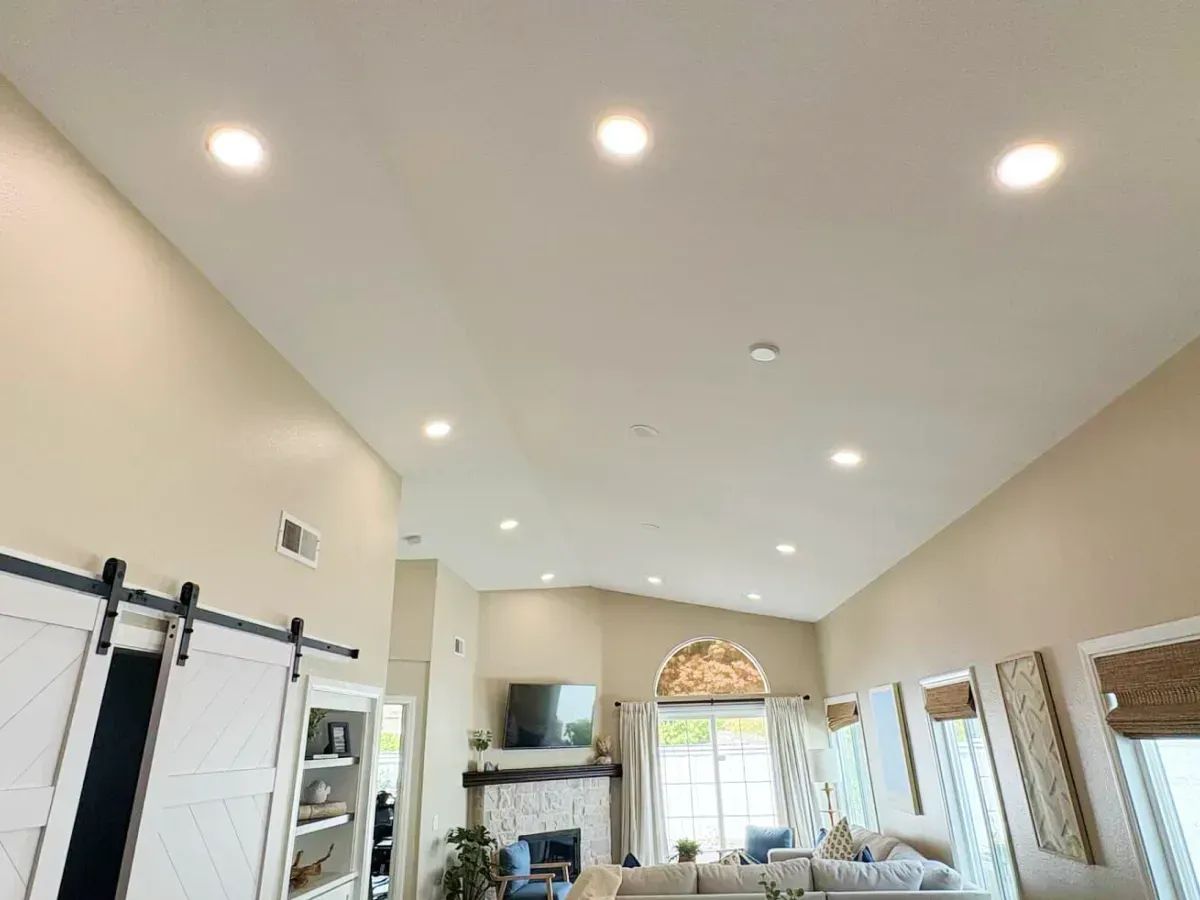
Quick Answer: Modern recessed lighting comes down to a handful of real choices: IC-rated cans for insulated ceilings, retrofit LED kits that drop into old housings, canless wafer lights for tight joist spaces, and gimbal trims for angled or accent light. IC-rated fixtures are built to sit safely against insulation, while non-IC fixtures need clearance to avoid overheating. Retrofit kits let you upgrade old recessed lighting to LED without opening the ceiling. Wafer lights fit almost anywhere because they need less than two inches of depth. Spacing generally follows a simple rule: divide your ceiling height by two to get the distance between fixtures. Most new LED recessed lights sold today already meet California's high-efficacy standard.
You flip on the old flush-mount fixture in your kitchen and it lights the room the way a flashlight lights a closet: one spot, glaring, and everything else in shadow. That's usually the moment homeowners across North County start looking into recessed lighting. Whether it's a kitchen remodel in Carlsbad, a living room refresh in Encinitas, or a coastal cottage in Leucadia that still has 1970s can lights sagging in the ceiling, the question is almost always the same. What actually goes into a modern recessed lighting installation, and which type fits your ceiling, your insulation, and the way you use each room?
The answer isn't one product. It's a handful of real choices, and each one solves a different problem.
Can Lights, Wafer Lights, and What Actually Fits Your Ceiling
Recessed lighting isn't a single product category anymore. Two very different builds now live under that name, and picking the wrong one usually comes down to not knowing the ceiling cavity you're working with.
Traditional Can Lights
These are the deep metal housings most people picture when they hear "recessed lighting." A can sits inside the ceiling, a trim ring covers the opening, and a bulb (LED, these days) screws or clips into a socket inside. Cans need real depth, usually five to seven inches above the ceiling line, and they have to dodge joists, ducts, and plumbing runs while they're at it.
Wafer Or Disc Lights
These are the newer, canless option. The whole fixture, driver and all, sits in a shallow puck less than two inches thick. No bulky housing, no clearance fight with a joist six inches off center. A wafer light mounts almost anywhere, which is why they've become the default for remodels where the attic space above is cramped or already packed with insulation.
Neither one is universally "better." Cans give you the option to swap bulbs later and work well when you're already opening the ceiling for a remodel. Wafers solve the space problem and tend to run cooler since the LED board sits flush against the ceiling instead of buried in a can.
IC-Rated vs. Non-IC-Rated: Why It Matters Once Insulation Is Involved
Here's the part that trips up a lot of DIY installs. Every can-style fixture is rated either IC or non-IC, and the letters stand for Insulation Contact.
An IC-rated can is built with thermal protection that lets insulation touch the housing directly without a fire risk. A non-IC can generates more heat at the housing and needs a gap, often three inches or more, between the fixture and any insulation around it. Cut that gap short and you've got a housing running hotter than it should, tucked under blown-in insulation that isn't going anywhere.
Most homes built or re-insulated in the last couple of decades have insulated ceiling cavities, attics included. That's why IC-rated fixtures have become close to standard in residential work. If your attic has loose-fill or batt insulation resting directly on the ceiling, non-IC cans just aren't the right call.
Tip:
If you're not sure whether your attic insulation touches your existing can lights, look for a small gap or "moat" cut around each fixture. No gap and no IC marking on the housing usually means it's due for an upgrade.
Retrofitting Old Can Lights Without Opening the Ceiling
Not every recessed lighting project starts from scratch. A lot of the work in older Vista and Oceanside homes is retrofit work: taking cans that already exist and bringing them up to LED without cutting drywall.
Retrofit kits screw or clip straight into an existing housing. The old bulb and trim come out, the LED module goes in, and in most cases the whole swap takes a few minutes per fixture. It's the fastest way to modernize a room full of old halogen or incandescent cans, and it sidesteps the ceiling work entirely.
The catch is that a retrofit kit only fixes the light source. If the original can is non-IC and it's buried under insulation it was never rated for, or the housing has degraded from decades of coastal humidity, swapping the bulb doesn't solve that. Sometimes the honest answer is a new housing, not a new bulb.
Adjustable Trims for Art, Accent Walls, and Task Lighting
Standard recessed trims point straight down. Gimbal trims don't. They pivot, usually somewhere between 20 and 35 degrees, so you can angle the beam toward a piece of art, a stone fireplace, or a kitchen island without the light spilling everywhere else.
This matters more than it sounds like it should. A living room with a mix of straight-down cans and one or two gimbal fixtures aimed at a focal wall reads completely differently than a room lit uniformly from above. It's the difference between a room that looks lit and a room that looks designed.
Adjustable trims cost a little more and take slightly longer to install correctly, since the angle has to be set and checked after the ceiling is patched. Worth it in a room where you actually want the light to do something besides fill space.
How Many Recessed Lights a Room Actually Needs
Overdo the spacing and you get a wall of glare. Underdo it and you're back to dark corners. The rule electricians use as a starting point is simple: take your ceiling height, divide it by two, and that's roughly your spacing between fixtures.
An 8-foot ceiling lands around 4 feet of spacing. A 9-foot ceiling stretches to about 4.5 feet. Distance from the wall usually runs half that spacing figure again, so on an 8-foot ceiling, the first row of lights sits about 2 feet in from the wall.
Kitchens break this rule on purpose. Task areas like islands and sinks want tighter spacing, often 30 to 36 inches apart, because you're working under that light, not just walking through it. Bedrooms flip the other direction: avoid placing a fixture directly above where the headboard will sit, since nobody wants to stare into a can light from bed.
Dimmer Compatibility and Why LEDs Buzz or Flicker
LED recessed lights don't dim the same way old incandescent bulbs did, and that mismatch is behind most of the buzzing, flickering, or "won't dim past halfway" complaints we hear from homeowners who swapped bulbs but kept the old dimmer switch.
Older dimmers were built for the higher electrical load of incandescent bulbs. LEDs draw a fraction of that power, and a dimmer that isn't rated for LED loads can struggle to read the circuit correctly. The fix usually isn't a different bulb. It's an LED-rated dimmer, often labeled ELV or TRIAC depending on the driver type in your fixtures, matched to the specific LED product installed.
Warning: A recessed light that buzzes loudly, flickers erratically, or feels warm to the touch at the trim isn't just annoying, it can point to a loose connection, an overloaded circuit, or a dimmer mismatch that's stressing the wiring. Stop using the dimmer at full range and have it checked before it becomes a bigger problem.
What "High-Efficacy" Means on Newer Recessed Fixtures
If you've shopped for recessed lighting recently, you've probably seen a fixture labeled "JA8" or "high-efficacy" on the box or spec sheet. That labeling refers to a set of performance benchmarks that California applies to lighting products, covering things like how much light a fixture produces per watt of power it draws and how quickly it reaches full brightness.
In practical terms, this just describes the fixture itself, not something you need to research or apply for. A JA8-labeled LED recessed light is already built to hit those efficiency marks out of the box. Most LED recessed products sold today, wafer lights included, are manufactured to this standard as a baseline, which is part of why LED has mostly replaced halogen and incandescent cans in new fixtures.
This is a manufacturing spec, not a homeowner decision. You don't need to calculate anything. If a fixture is labeled high-efficacy or JA8, it was built to meet that bar before it left the factory.
Coastal Air and Ceiling Cavities Change the Calculation
North County isn't a uniform climate zone once you get within a few miles of the coast. A home in Solana Beach or Del Mar deals with salt-laden air working its way into fixtures, connectors, and can housings in a way that an inland Escondido home simply doesn't. Metal components corrode faster near the water, and that includes the housing and trim on a recessed light, not just outdoor fixtures.
For rooms near exterior walls or in homes within a mile or two of the coast, wet-rated or damp-rated trims hold up better over the years than standard interior-rated cans. It's a small spec difference on paper, but it's the reason a can light installed in a coastal bathroom or covered patio ceiling ten years ago might already be showing rust on the trim ring while the same fixture inland still looks new.
Older homes throughout the region add another wrinkle. A lot of houses built before the 1990s have ceiling cavities that were insulated after the fact, sometimes unevenly, sometimes with materials that have settled or shifted over decades. That's exactly the situation where confirming a fixture's IC rating before installation matters, rather than assuming the last owner got it right.
A Better Finish for Modern Recessed Lighting
Choosing recessed lighting is ultimately about matching the fixture to the ceiling, the room, and the home's environment. IC-rated cans make sense where insulation is present, wafer lights solve shallow-ceiling challenges, and retrofit LEDs can modernize existing housings without disturbing finished drywall. Thoughtful spacing, compatible dimmers, and adjustable trims also help create lighting that feels intentional rather than simply brighter. In coastal North County, fixture ratings and material durability add another consideration, especially in older homes where ceiling conditions can vary.
For homeowners comparing options in the North County San Diego area, Panelectric Inc
brings 20
years of experience to recessed lighting projects in Carlsbad, Encinitas, Vista, Oceanside, and surrounding communities. The right installation starts with understanding what is above the ceiling as much as what is visible below it. Once insulation, available depth, electrical connections, room function, and lighting goals are considered together, the result is a cleaner and more comfortable lighting design that works naturally with the home.
Frequently Asked Questions
What's the real difference between IC-rated and non-IC-rated recessed lights?
IC-rated fixtures are built with thermal protection so insulation can touch the housing directly. Non-IC fixtures run hotter and need a clearance gap, usually three inches or more, between the housing and any surrounding insulation.
Can I upgrade old can lights to LED without cutting into my ceiling?
In most cases, yes. Retrofit LED kits install directly into existing can housings without any drywall work. The exception is when the existing housing itself is damaged, non-IC in an insulated ceiling, or otherwise not fit to keep using.
Are wafer lights as bright as traditional can lights?
Wafer lights are available in the same lumen ranges as standard can-based LEDs, so brightness isn't really the tradeoff. The difference is depth and installation flexibility, not output.
How many recessed lights does an average room need?
Start with the ceiling-height-divided-by-two rule for general spacing, then adjust for the room. Kitchens and work areas want tighter spacing over counters and islands, while bedrooms and living rooms can space out further for ambient light.
Do all LED recessed lights work with any dimmer switch?
No. Many older dimmers weren't built for the lower electrical load LEDs draw, which causes flickering, buzzing, or a limited dimming range. Matching an LED-rated dimmer to the specific fixture usually resolves it.
What does "JA8" or "high-efficacy" mean on a light fixture label?
It's a manufacturing benchmark California applies to lighting products, covering efficiency and performance specs like lumens per watt. Fixtures labeled this way are built to meet those marks before they're sold, so it isn't something a homeowner needs to calculate or apply for.